This is the second part of a two-part series. The first part was about the career anxiety. This one is about the version of the same question that is harder to sit with.
I wrote most of it back in March and then left it sitting in drafts for six months, which probably tells you how comfortable I am with the subject. What follows is that draft, plus what happened while it sat there.
Again: nothing here is new. Everyone who is a parent and works in tech is having some version of this thought. I am writing it out because writing it out is the only thing I know how to do with something I cannot resolve.
Old code Link to heading
Earlier this year I was sorting through old files and found code I had written at university, about twenty years ago. It was full of problems. Bad variable names, tangled logic, no tests, structure that made sense to my twenty-year-old self and nobody else.
But I remembered writing it. I remembered the specific problem I was trying to solve. I remembered it taking weeks, staying up late, getting stuck, eventually getting unstuck. Being genuinely proud of it.
A single prompt would generate the whole thing now. Probably better.
I do not think the problem is that students today can just ask an AI to do it. The problem is that the option exists even when they are trying not to use it. The context has changed. Whether or not they use the tool, the nature of the effort has changed, and I am not sure what that means for the actual learning. I am also not sure I am the right person to decide, because my intuition here is shaped by a world that no longer exists.
My son and ChatGPT Link to heading
My son was eight when I started writing this. He asked me one evening if he could use ChatGPT to help with his homework.
I said no. He accepted that. But I spent a while afterwards thinking about whether I gave the right answer.
The honest version: I do not know if it was right. I know what my instincts said, and my instincts said that he needs to learn to think before he learns to prompt. But I also know that instinct is based on a version of education that was built for a world before this tool existed. I cannot be entirely certain my reasoning is about his development rather than my own discomfort.
What I am more comfortable with is supervised use for creative things he is genuinely curious about. He is obsessed with flags and historical empires, and over a few weeks he had a run of these conversations. In one of them he had it dig through real empires before inventing his own. In another, when it gave him something close but not quite right, he typed “bruh that’s not what I said.”
He was eight years old and he told an AI “bruh.”
I laughed. But I also noticed something: he was completely at ease with it in a way I am not, even now. It was just a tool. Slightly annoying when it got things wrong, helpful when it got things right. No anxiety attached. No novelty.
That ease is probably fine. It might even be necessary. But it is a different relationship than I have with these tools, and I am not sure what it produces over time.
I did not think to keep any of it at the time. The one conversation I still have is the flag, and it is worth walking through, because it is not quite the story I thought I was telling.
He typed the brief in one go, no punctuation, no hesitation: two red stripes, the UN emblem in the middle, the word RUNE across it, standing for Republic United Nations Empire.
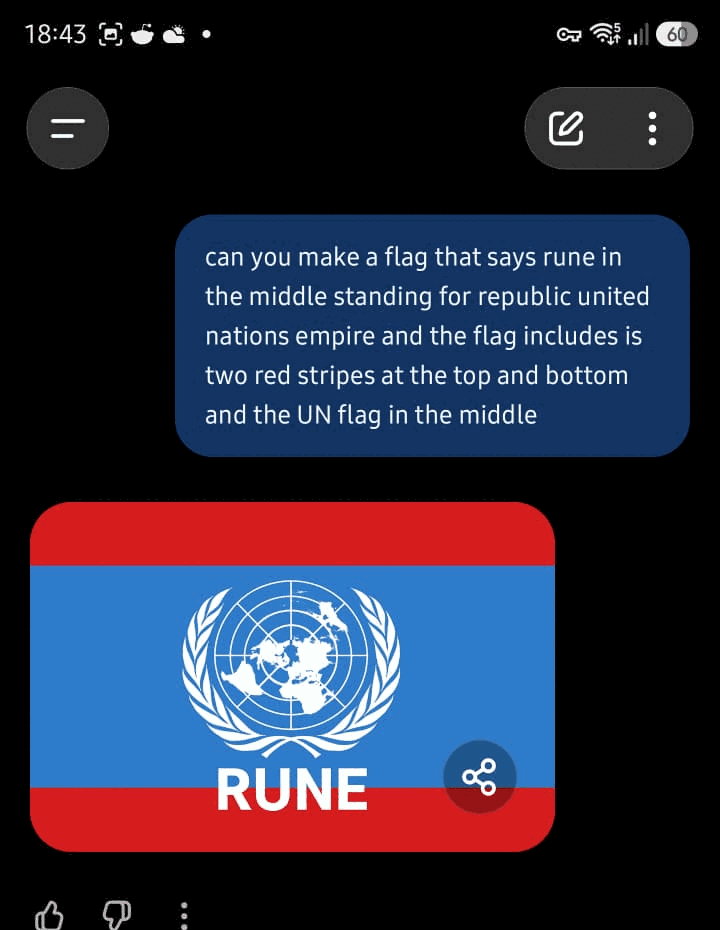
It gave him a flag. He typed “make the writing smaller”. It gave him another one. He typed “great”, then “no its perfect imma save it”, and that was the end of it.
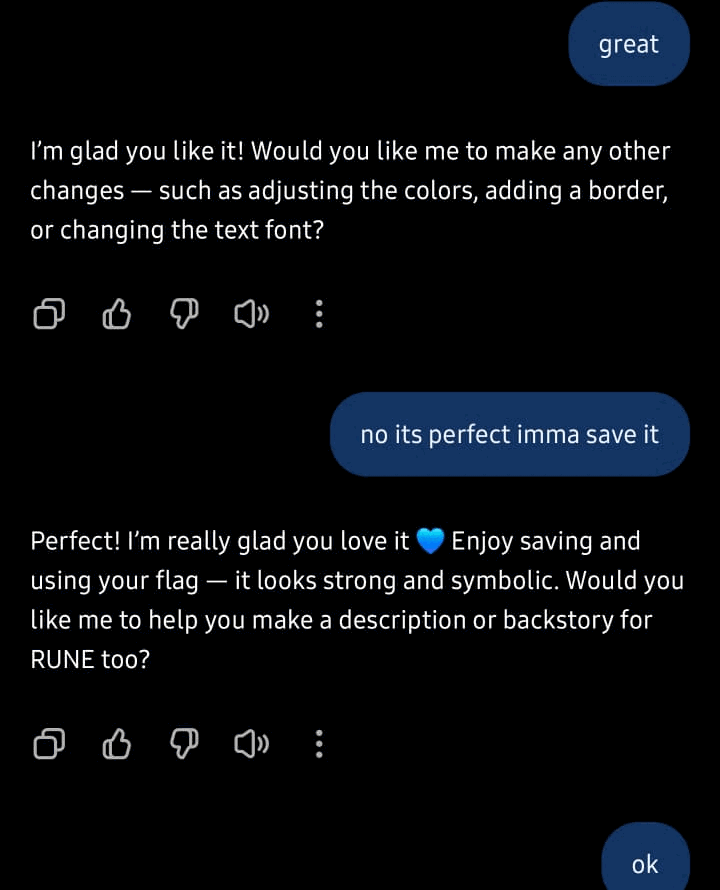
Look at what he asked for, though, and what he got back. He specified the shapes and the colours. He never said what the empire stood for. The machine decided that for him: a motto, “Unity in Power, Peace in Strength”. Red for valour and sacrifice. Blue for peaceful collaboration. A federation combining republic governance with imperial stability. Then it asked whether he wanted the constitution written as an official statement or as a mythic origin story.
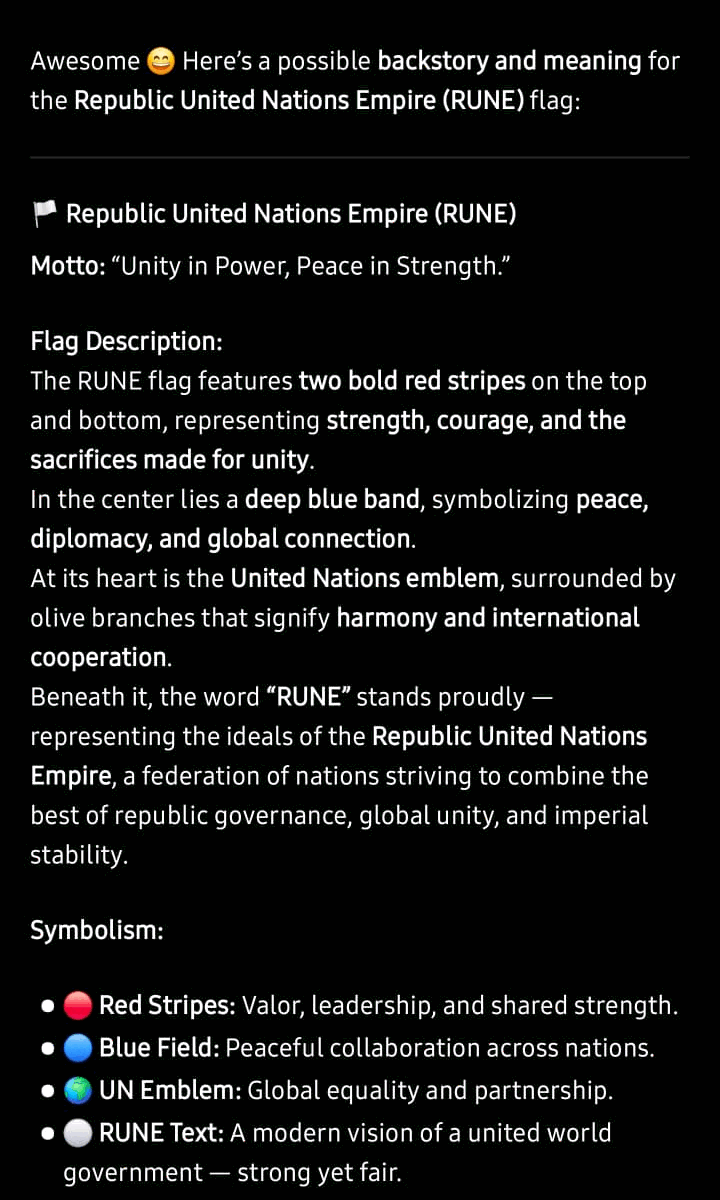
He said ok. Every reply it gave him ended with an offer to do more, and he said ok.
None of that was his. He asked for a picture and was handed a worldview to go with it, and he has no particular reason yet to notice the difference. That is the part I keep turning over. Not that he used the tool, but that the tool did not stop at the thing he asked for.
A few months later: Roblox Link to heading
When I first drafted this post, my son was using AI to make flags for imaginary empires. That is not where it stayed.
He has been playing Roblox for years, and a few months ago he decided he wanted to build his own game. I found him a Udemy course aimed at complete beginners. I have no idea whether it is any good. I gave it to him mostly so he would get a feel for Roblox Studio.
He watched a few chapters and then stopped, and started asking ChatGPT and Gemini instead, both on the free plans. He does not understand most of what he is doing. But he understands more of it than he did: where the code goes, roughly what a given block does, how to describe a problem well enough to get back an answer he can act on. He is using it as a tutor that never runs out of patience with him.
I told him no for homework. I did not tell him no for this, and I am not sure the distinction holds up as well as I want it to. The line I drew was between doing the work and getting the work done for you, and I am no longer confident I can tell which side of it he is on.
The code I found from university took me weeks, and I was proud of it. He is nine now, and he is further into a working game than I would have been at twice his age, without the weeks. I do not know whether that means he is learning faster than I did, or learning something else entirely. I will not know for years.
My wife’s assignment Link to heading
My wife is completing a childcare qualification. She submitted an assignment and the feedback came back asking her to rewrite certain sections in her own words. The implication was clear.
She had not used AI. At all.
The feedback was wrong. But the feedback was also understandable, because the suspicion is now baked in. Institutions have had to change their defaults because enough people are using these tools that the assumption of human-written work is no longer reliable.
The result is that people who are not using AI are being caught in the backlash against people who are. My wife did the work. She wrote the assignment. And she still had to sit with the implication that she might not have.
That is a different kind of harm than the disruption to jobs or education. It is the erosion of assumed good faith. The system has changed whether you opted in or not.
What they are growing up in Link to heading
My kids do not see a clean distinction between content and AI-generated content. Nobody under a certain age does. Their feeds mix AI-generated videos of fruit doing absurd things with news clips that may or may not be real, with genuine family footage, with things that are clearly satire and things that look like satire but are not.
Critical thinking about what is real is now a survival skill. That is not an overstatement. The ability to pause, to ask who made this and why, to hold a piece of content up to the light before accepting it, is genuinely necessary for navigating the information environment they are growing up in.
That is not a new parenting problem. Parents have always had to teach their children to be sceptical of what they read and watch. But the volume and the sophistication have changed. The cost of producing convincing fake content has dropped to near zero. The infrastructure for distributing it is the same infrastructure that distributes everything else.
I do not think I can protect my kids from that. I think the only thing I can do is try to teach the habit of questioning. Whether they will actually apply it when they are twelve and doom-scrolling is a different question.
What do you actually tell them? Link to heading
That is the real question, and I do not have a clean answer.
I cannot tell them not to use AI, because by the time they are in the workforce it will be as embedded as spreadsheets. I cannot tell them to use it freely, because the relationship between effort and learning is something I do not fully understand in this new context. I cannot tell them what jobs will exist, or what skills will matter, or what kind of thinking will still be valued.
My instinct is: teach them to think. Teach them to question. Teach them that a tool is only as good as the judgment of the person using it, and that judgment takes years to develop and cannot be skipped. Teach them that being able to evaluate AI output is a skill in itself, and that it requires knowing the subject well enough to know when the AI is wrong.
That feels right. It also feels like the kind of thing every generation says to the next one, dressed up in the vocabulary of whatever the new technology is. I am not sure it is enough.
Where this ends up Link to heading
I do not have a resolution here. Neither of these posts does.
What I have is the weight of it. The university code I was once so proud of. My son typing “bruh” at an AI without a second thought. My wife rewriting an assignment she wrote herself. My kids watching videos where nothing is quite verifiable.
The question of what to tell them is not rhetorical. I am genuinely asking. I am also aware that I am part of the first generation of parents who has had to answer it in this specific form, which means there is no received wisdom to fall back on.
That sits with me. I do not think it is going anywhere soon.